The AI Resume Paradox: Why 62% of Employers Are Rejecting AI-Written Resumes (And How to Fix Yours)
You finally did it. You spent an entire Sunday afternoon feeding your teaching experience into ChatGPT, asking it to "make my resume sound corporate," and what came out looked... professional. Clean. Maybe even impressive?
Then you applied to 47 jobs.
And heard back from... zero.
You're not alone. And here's the thing — it's probably not your experience that's the problem. It's how you're using AI.
Let me just say the quiet part out loud: AI can absolutely help you write a killer resume — but only if you know how to use it right. The problem is that most teachers are using it wrong, and recruiters can smell a generic AI resume from a mile away.
In this post, I'm going to break down exactly why AI-generated resumes are getting rejected at record rates, what recruiters are actually looking for, and how you can use AI as a tool (not a crutch) to land that corporate job.
Quick background: I'm a former teacher who made the jump to corporate. Now I'm an Instructional Design Manager running full-cycle hiring for a healthcare organization. I've reviewed thousands of resumes — and I can tell you exactly what's working and what's getting auto-rejected in 2025.

THE NUMBERS DON’T LIE: WHAT’S ACTUALLY HAPPENING IN 2025
Here's the reality: AI has taken over hiring. According to a 2025 Resume Now survey, 91% of employers now use AI in their hiring process. That's not a typo — nine out of ten companies are using algorithms to screen you before a human ever sees your application.
But here's where it gets interesting (and a little ironic):
• 68% of job seekers are now using AI to write their resumes
• 62% of employers say they reject resumes that "lack a personal touch"
• Only 26% of applicants trust AI to evaluate them fairly
So let me get this straight: Everyone's using AI to write resumes. Companies are using AI to screen resumes. And somehow... everyone's still getting rejected?
Yep. Welcome to the AI Resume Paradox.
WHY YOUR CHATGPT RESUME ISN’T WORKING
I've seen hundreds of AI-generated teacher resumes come across my desk. And I can usually spot them in about three seconds. Here's what gives them away:
1. The "Thesaurus Explosion" Problem
You know that resume that says you "orchestrated synergistic learning experiences to optimize student outcomes"? That's AI trying too hard. No human talks like that — and recruiters know it.
When I read that, I don't think "wow, this person is sophisticated." I think "wow, this person let ChatGPT do all the work."
2. The "Copy-Paste Generic" Problem
AI doesn't know YOUR story. It doesn't know that you turned around a failing reading program or that you coached the debate team to state championships while teaching five preps. It just knows what a "typical" teacher resume looks like—and spits out something that sounds like everyone else.
When 68% of people are using the same tools to generate the same kind of content... you all start to sound the same.
3. The "Missing Numbers" Problem
AI-generated resumes are notoriously bad at quantifying achievements. They'll say things like "improved student performance" instead of "increased reading proficiency scores by 23% across 127 students."
Recruiters love numbers. AI resumes rarely have them because ChatGPT doesn't know your numbers—only you do.

💡 Here's the good news: This isn't about avoiding AI — it's about using it STRATEGICALLY. The teachers who are landing interviews right now aren't the ones who refused to use AI. They're the ones who learned how to use it as a starting point, not a final product.
Need help making your resume sound like that? Let me give you a free Resume Review! Check it out here:
WHAT RECRUITERS ARE ACTUALLY LOOKING FOR (From Someone Who Does The hiring)
Let me pull back the curtain on what I'm scanning for when resumes hit my desk. And yes — skills-based hiring is real now. 85% of employers are using it in 2025, which means your teaching degree matters less than you think, and your actual abilities matter more than ever.
Here's what makes me stop scrolling:
Specificity Over Fluff
"Managed a classroom" tells me nothing. "Facilitated differentiated instruction for 32 students across 4 reading levels, resulting in 89% meeting grade-level benchmarks" tells me everything.
Corporate Language (That Still Sounds Human)
You need to translate your experience—but you don't need to sound like a robot doing it. There's a difference between "leveraged pedagogical frameworks to actualize learning outcomes" and "designed training programs that helped struggling students catch up."
Both are "corporate." One sounds human. Guess which one I'm calling for an interview?
Evidence of Impact
I want to see that you made a difference. Numbers are ideal, but even qualitative evidence works: "Selected by principal to mentor 3 first-year teachers" or "Chosen to pilot district-wide curriculum initiative."
HOW TO USE AI THE RIGHT WAY (The 70/30 Rule)
Here's my framework for using AI without losing your soul (or your chances at getting hired):
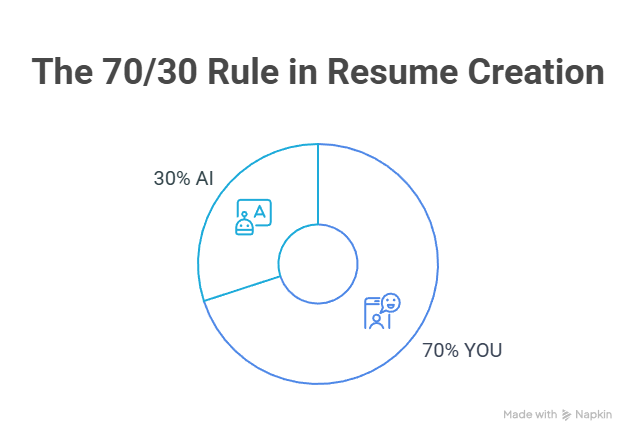
70% YOU, 30% AI.
That means AI handles the tedious stuff—formatting, initial keyword optimization, brainstorming language options. But YOU bring the specifics, the numbers, the stories, and the final polish.
Step 1: Start With Your Raw Material
Before you even open ChatGPT, write down:
• 3-5 specific accomplishments with numbers (students impacted, percentages improved, programs created)
• Your "story"—why are you making this change? What drives you?
• Keywords from the job posting you're targeting
Step 2: Use AI for Translation, Not Creation
Instead of asking AI to "write my resume," try:
"I increased my students' reading scores by 23% over one year by implementing a new literacy intervention program. Help me phrase this for a corporate L&D resume while keeping the specific numbers."
See the difference? You're giving AI the facts and asking it to help with language—not asking it to invent your career for you.
Step 3: The "Would I Say This Out Loud?" Test
After AI gives you options, read them out loud. If you'd feel ridiculous saying it in an interview, rewrite it. If it sounds like a thesaurus threw up on your resume, rewrite it.
Your resume should sound like the best, most professional version of YOU—not like a corporate robot.
Step 4: Customize for Every Single Application
This is where AI can actually save you time. Use it to quickly adjust keywords and phrasing for each job posting. But the core content—your stories, your numbers, your personality—stays consistent.
BEFORE & AFTER: REAL RESUME TRASFORRMATIONS
Let me show you what this looks like in practice:
❌ BEFORE (Pure AI-Generated):
"Leveraged innovative pedagogical methodologies to facilitate optimal educational outcomes for diverse learner populations, demonstrating exceptional proficiency in curriculum actualization and stakeholder engagement protocols."
✅ AFTER (70/30 Approach):
"Designed and implemented a differentiated reading intervention program for 127 students across 4 reading levels, resulting in 23% improvement in benchmark scores and selection to train 12 district teachers on the methodology."
Same person. Same experience. Completely different results.
The second version has specifics, numbers, and proof of impact. It sounds like a real human wrote it—because a real human DID write it, with AI as a tool.
Don't Forget: The ATS Is Still Watching
Here's something most teachers don't realize: Even if a human eventually reads your resume, it has to get past the ATS (Applicant Tracking System) first. And in 2025, these systems are smarter than ever.
Quick ATS survival tips:
• Use keywords from the job posting (AI is great for identifying these)
• Keep formatting simple—no tables, columns, or fancy graphics
• Use standard section headers (Experience, Education, Skills—not "My Journey")
• Save as .docx or PDF depending on what the application requests
The goal is to be both ATS-friendly AND human-readable. AI can help with the first part—but only you can nail the second.
The Bottom Line: It's Not AI vs. Human—It's AI + Human
Look, I get it. You're burned out. You're trying to escape a profession that's been draining you for years. The idea of letting AI handle your resume while you focus on, I don't know, existing—is tempting.
But here's the truth: Your teaching experience is valuable. Incredibly valuable. You've managed teams (students count!), handled high-stakes situations, communicated with difficult stakeholders, and probably created more training content in a year than most corporate employees create in five.
Don't let AI flatten that experience into generic corporate speak. Use it as a tool. Let it handle the tedious parts. But make sure YOUR voice, YOUR numbers, and YOUR story come through.
That's how you stand out in a sea of AI-generated sameness.
That's how you get the interview.
And that's how you finally make the career change you've been dreaming about.
Frequently Asked Questions
Is it bad to use AI to write my resume?
No—as long as you're using it as a tool, not a replacement. Use AI for brainstorming language, formatting, and keyword optimization. But your specific accomplishments, numbers, and voice need to come from you. The 70/30 rule (70% you, 30% AI) is a good framework.
Can recruiters tell if I used ChatGPT for my resume?
Often, yes. AI-generated resumes tend to have telltale signs: overly formal language, lack of specific numbers, generic phrasing that could apply to anyone. The key is to add your unique details back in so your resume sounds like a real person—because recruiters are specifically looking for that personal touch.
How do I translate teaching experience to corporate jobs?
Focus on transferable skills: curriculum development becomes "program design," classroom management becomes "team facilitation," parent conferences become "stakeholder communication." But don't just swap words—add specific numbers and outcomes to prove your impact. Check out my [HYPERLINK: free eBook] for 50+ translation examples.
What ATS-friendly format should I use for my resume?
Keep it simple: single-column layout, standard fonts (Arial, Calibri, Times New Roman), clear section headers (Experience, Education, Skills), and no tables, graphics, or fancy formatting. Save as .docx unless the application specifically requests PDF. This ensures the ATS can properly parse your information.
I've applied to dozens of jobs with no callbacks—what am I doing wrong?
The most common issues I see: generic resumes that aren't tailored to each job, missing keywords from the job posting, lack of quantified achievements, and teacher-speak that hasn't been translated for corporate audiences. [HYPERLINK: Get a free resume review] and I'll pinpoint exactly what needs to change.
🎯 Click here to get professional help that will help you go from 0 interviews to dream job in no time — let’s make your amazing experience sound like the powerhouse it is.

