Job Search Fatigue Is Real. Here's How to Stop Spinning Your Wheels (And Actually Get Hired)

You've sent out 50 applications. Maybe 100. Maybe you've lost count.
Every morning, you scroll through job boards. You tweak your resume. You write another cover letter. You hit "submit" and feel a tiny spark of hope.
Then... nothing. No callback. No interview. Just the occasional automated rejection email that somehow makes it worse.
And you start to wonder: Is it me? Am I just not good enough?
Let me just say the quiet part out loud: It's not you. It's your strategy.
If you're feeling exhausted, demoralized, and honestly a little hopeless about your job search right now—you're not alone. According to a recent Glassdoor survey, 70% of workers feel hopeless about their 2026 job search. "Fatigue" was literally the word of the year for job hunting in 2025.
But here's what nobody's telling you: The problem isn't that you need to apply MORE. The problem is that you're applying at the wrong time, in the wrong way, with the wrong materials.
And I can prove it.
When I left teaching, I was hired in six weeks. Not six months—six weeks. And no, it wasn't luck. It wasn't connections. It was because I did something that most career changers get completely backwards.
I'll show you exactly what that was. But first, we need to talk about why your current approach is burning you out.
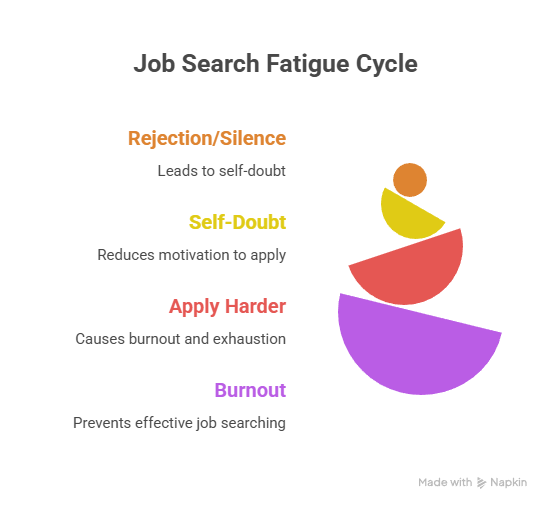
The Real Problem: You're Measuring Success Wrong
Here's the mindset trap that's killing your motivation:
If your definition of "success" is getting a job, then every single day of your job search is a failure—until the day you get hired.
Think about that. You could apply for months, do everything "right," and still feel like you're failing every. single. day. No wonder you're exhausted.
This is why the "just keep applying!" advice is so toxic. It puts all your emotional eggs in one basket that someone else controls. You can't make someone hire you. You can only control whether you're worth hiring.
The Reframe That Changed Everything For Me
I stopped measuring success by "did I get a job today?" and started measuring it by "did I increase my value today?"
• Did I learn a new skill? Success.
• Did I add a project to my portfolio? Success.
• Did I update my LinkedIn with new evidence of my expertise? Success.
• Did I make a connection with someone in my target industry? Success.
See the difference? With this mindset, you can win every single day—regardless of whether anyone has hired you yet. Your momentum builds. Your confidence builds. And ironically, that's exactly when the interviews start coming.
💡 Key Insight: You can't control whether someone hires you. You CAN control whether you're worth hiring. Focus there first.
Why Most Teachers Get It Completely Backwards
Here's what I see teachers do all the time:
They decide to leave teaching. They dust off their resume. They start applying to jobs. They get rejected. So they start "upskilling"—taking courses, watching tutorials, learning new tools—while continuing to apply.
This is backwards. And it's why they stay stuck.
Think about it logically: If you've applied to 50 jobs and gotten zero interviews, your current "product" (you, your resume, your experience as presented) isn't selling. Continuing to apply with that same product is like a salesperson making 50 cold calls, getting rejected every time, and thinking "I just need to make MORE calls!"
No. You need a better product first.
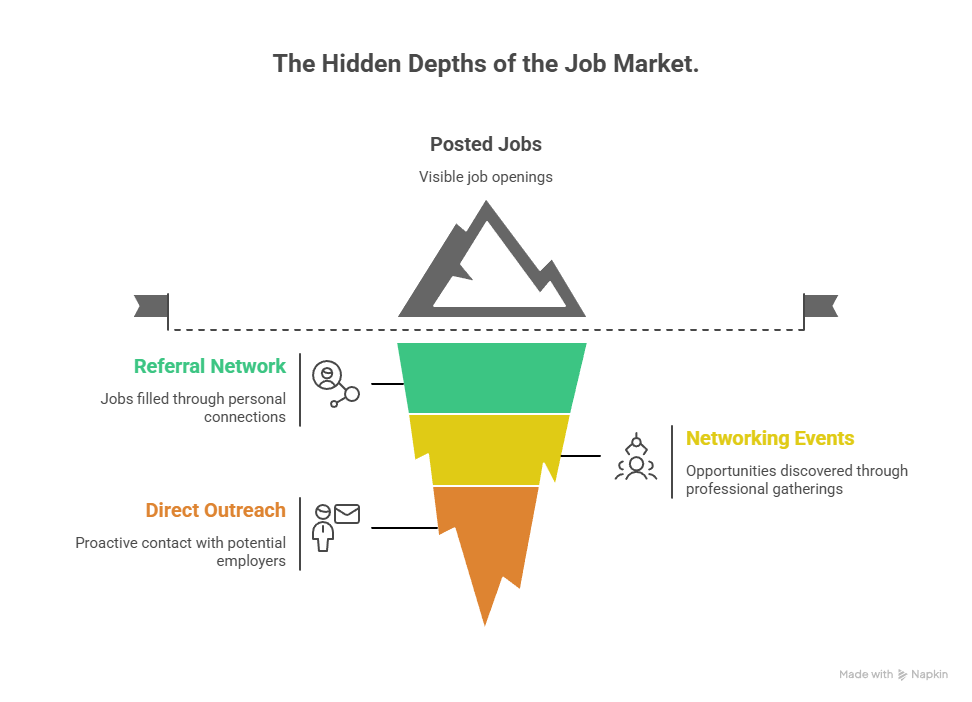
Here's another stat that should stop you in your tracks: 70-85% of jobs are never even posted publicly. They're filled through referrals and networking. And interviews that come from referrals are 35% more likely to result in job offers than those from online applications.
So if you're spending 100% of your energy on applications to posted jobs, you're fighting for maybe 15-30% of the opportunities—and competing against hundreds of other applicants for each one.
That's not a strategy. That's a lottery ticket.
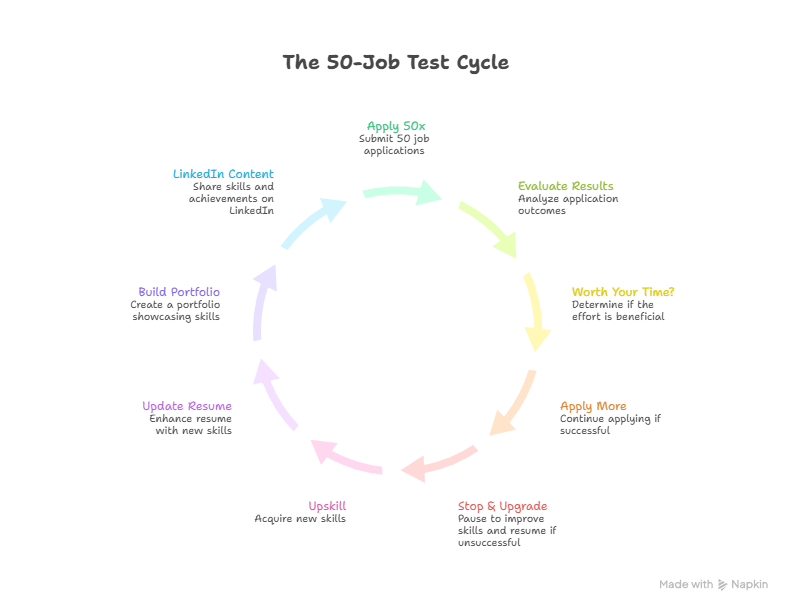
The 50-Job Test: A Framework That Actually Works
Here's the approach I used—and that I now teach to every teacher I work with. I call it The 50-Job Test, and it's designed to stop the fatigue cycle and get you actual results.
Step 1: Apply to 50 Jobs (Yes, Really)
Start by applying to 50 jobs that you're genuinely qualified for. Don't half-ass it—actually customize your applications. Track everything in a spreadsheet.
This isn't about getting hired. This is about collecting data.
Step 2: Evaluate Your Results
After 50 applications, check your numbers:
• 0-1 interviews: Your application materials and/or qualifications need work. Stop applying immediately.
• 2-3 interviews: You're on the right track. Applying IS worth your time. Keep going and refine.
• 4+ interviews: You're cooking. Apply like the wind.
Here's the truth most people don't want to hear: If you're getting zero interviews from 50 applications, continuing to apply is a waste of your time. Your time is better spent increasing your value until applications actually make sense.
Step 3: If It's Not Working—STOP and Upgrade
This is where most people fail. They keep applying out of desperation. Don't.
Instead, invest your energy in actually becoming more hireable:
• Upskill: Take courses, get certifications, learn the tools your target industry uses
• Update your resume: Reflect your new skills. Translate teacher-speak to corporate language
• Build your portfolio: Create PROOF of what you can do, not just claims
• Create LinkedIn content: Position yourself as an expert in your target field BEFORE you apply
Step 4: Test Again
Once you've meaningfully upgraded your skills and materials, run The 50-Job Test again. Check your interview rate. Repeat the cycle until applications are actually worth your time.
🎯 Not sure if your resume is the problem? [Get a Free Resume Review] and I'll tell you exactly what's holding you back.
Why I Was Hired in 6 Weeks (It Wasn't Luck)
I want to be honest with you: My transition was fast. Like, really fast. But it wasn't because I got lucky or had connections.
It was because I did all the "upgrade" work before I ever decided to leave teaching.
I built a portfolio—not because I was planning to quit, but because I was genuinely interested in instructional design. I collected stats on my classroom impact because I'm a data nerd. I started posting on LinkedIn about learning and training because I had opinions and wanted to share them.
By the time I actually started applying, I had:
• A portfolio that PROVED I could do the job
• Stats and evidence of my impact
• A LinkedIn presence that positioned me as a professional in the field
• A resume that spoke corporate language
I wasn't asking companies to take a chance on me. I was showing them exactly why hiring me was a smart decision. The interviews came easy because the work was already done.
Could I pump out applications quickly? Yes—because I wasn't spending hours agonizing over each one. I was confident in my materials. I had evidence. The application process became a numbers game I could win.
What You Should Do Today (Not Tomorrow—Today)
If you're stuck in the fatigue cycle, here's your action plan:
If you've been applying with no results:
1. Stop applying. Seriously. Take a break. The job boards will still be there.
2. Audit your materials. Is your resume in corporate language? Do you have evidence of your skills? Does your LinkedIn look professional?
3. Identify one skill gap. What's one thing people in your target role can do that you can't (or can't prove)? Focus there.
4. Build one piece of evidence. A portfolio project, a case study, a certification—something tangible.
5. Then test again. Apply to 50 more jobs and see if your results improve.
If you haven't started applying yet:
Good. You have an advantage. Don't waste it by rushing into applications before you're ready.
Spend the next 4-8 weeks building your foundation: upskill, create a portfolio, translate your resume, start posting on LinkedIn. Then start applying—and watch how different the results are.
Bonus: Stop Ignoring the Hidden Job Market
Remember that stat about 70-85% of jobs never being posted? While you're upgrading your skills, you should ALSO be building relationships.
• Connect with people in your target industry on LinkedIn
• Comment thoughtfully on their posts
• Ask for informational interviews (not jobs—information)
• Join communities and groups in your field
• Share your learning journey publicly
The referrals that come from genuine relationships are worth 10x any online application. I know "networking" sounds gross if you're an introvert teacher—but it's really just talking to people who do what you want to do. You're already good at talking to people. That's literally your job.
The Bottom Line: You're Not Broken
If you're exhausted from job searching, I need you to hear this:
You're not broken. The advice you've been following is broken.
"Just keep applying" doesn't work when your materials aren't landing. "Stay positive" doesn't work when every day feels like failure. You need a different approach.
Stop measuring success by whether you got a job today. Start measuring it by whether you got better today.
Stop applying endlessly to posted jobs. Start building relationships and proof of your value.
Stop applying while upskilling. Start upskilling until applications are worth your time.
Your teaching experience is valuable. You have skills that companies desperately need. You just need to prove it—to yourself first, and then to them.
Now go build something. 🎯
Ready to Rework Your Resume?
If you're not sure where to start, I've got you! 🎯
[Click here to get professional help] that will help you go
from 0 interviews to dream job in no time—let's make your amazing
experience sound like the powerhouse it is.
Or grab my [FREE 200+ eBook] to start building your foundation today.
Frequently Asked Questions
How many job applications should I send before expecting results?
Use the 50-Job Test as your benchmark. After 50 well-targeted, customized applications, you should be getting at least 2-3 interview requests if your materials are working. If you're getting zero, that's valuable data telling you to stop and upgrade before applying more.
How long should a career change from teaching take?
It varies wildly depending on your preparation. If you've built a portfolio, upskilled, and translated your experience before applying, it can happen in weeks. If you're applying with a generic resume and no proof of your new skills, it could take months—or never happen. The preparation phase is what most people skip, and it's what makes all the difference.
Should I apply to jobs while I'm still learning new skills?
Generally, no. If you're getting zero interviews, your current "product" isn't selling—continuing to apply with it is a waste of time and emotional energy. Focus on upskilling and building evidence of your abilities first. Once you've meaningfully improved, THEN test the market again. The exception is if you're getting some interviews but not offers—then the problem might be your interview skills, not your application materials.
What if I don't know anyone in the corporate world?
Most teachers don't! You build from scratch by: connecting with people on LinkedIn, commenting thoughtfully on their content, requesting informational interviews (to learn, not to ask for jobs), joining professional communities, and sharing your own learning journey publicly. The hidden job market isn't about who you know TODAY—it's about who you'll know six months from now if you start building relationships.
How do I deal with job search depression and burnout?
First, recognize that the way you're measuring success might be the problem. If "getting a job" is your only metric, you'll feel like a failure every day until you're hired. Reframe: success is becoming more valuable, building your skills, expanding your network—things you CAN control. Second, if applications aren't working, STOP. Take a break. Focus on building instead of applying. The job boards will still be there, and you'll return with better materials and a clearer head.

